Easy Data Transform accepts the following command line arguments:
Argument |
Description |
||||||||||||
|---|---|---|---|---|---|---|---|---|---|---|---|---|---|
<file name> |
The .transform file to open at start-up. |
||||||||||||
-build |
Output the Easy Data Transform build time and date. -cli must also be set. |
||||||||||||
-cli |
Hide the graphical user interface. Close the application once any processing on the opened file is complete. |
||||||||||||
-log <location> |
Writes the command line output to the file at <location>. -cli must also be set. |
||||||||||||
-overwrite |
Overwrite an existing log file with the same location. The log file will be appended to if this argument is not present. -log <location> must also be set. |
||||||||||||
-file <alias>=<location> |
Sets the input or output file with the given alias to the location specified, e.g. c:\data\file.csv. Input Excel files should include the sheet name, e.g. c:\data\file.xlsx[sheet]. Output Excel files may optionally include a sheet name. The file type should be the same as the original. |
||||||||||||
-folder <alias>=<location> |
Sets the input folder with the given alias to the location specified, e.g. c:\data\*.csv. Add a + at the end to recursively include sub-folders, e.g. c:\data\*.csv+. Input Excel files should include the sheet name, e.g. c:\data\*.xlsx[*]. The file type should be the same as the original. |
||||||||||||
-new_window |
Don't load the last opened .transform file, even if open previous file at start-up is checked in Preferences. |
||||||||||||
-verbose |
Equivalent to -verbosity 2. Maintained for backward compatibility. Use -verbosity <level> instead. |
||||||||||||
-verbosity <level> |
Output additional information to the terminal.
-cli must also be set. |
||||||||||||
-version |
Output the Easy Data Transform version number. -cli must also be set. |
This allows you to run Easy Data Transform from the Windows Command Prompt or a .bat file. For example:
To run C:\Users\andy\Documents\myfile 1.transform with the output with alias output1 output instead to C:\Users\andy\Documents\data1.csv:
"C:\Program Files\EasyDataTransform\EasyDataTransform.exe" "C:\Users\andy\Documents\myfile 1.transform" -file "output1=C:\Users\andy\Documents\data1.csv" -cli -verbosity 2
To run C:\Users\andy\Documents\myfile2.transform with the input with alias input1 input instead from sheet sheet1 of C:\Users\andy\Documents\data 2.xlsx:
"C:\Program Files\EasyDataTransform\EasyDataTransform.exe" "C:\Users\andy\Documents\myfile2.transform" -file "input1=C:\Users\andy\Documents\data 2.xlsx[sheet1]" -cli -verbosity 2
To use wildcards to transform multiple input files in a folder, you can use the for command:
for /f "delims=" %f in ('dir /b C:\Users\andy\Desktop\cli\*.csv') do ( "C:\Program Files\EasyDataTransform\EasyDataTransform.exe" "C:\Users\andy\Desktop\cli\mytransform.transform" -file "cli-in=%f" -cli -verbosity 2 )
Note:
•"delims=" is required if file names can contain spaces.
•You may have to pause after each run to stop the output from different runs overlapping.
•The variable needs to be %f in a Windows command shell and %%f in a Windows .bat file.
•You can also use the Windows forfiles command, but it is quite brittle, so we don't recommend it.
Use file name variables to dynamically change output file names based on input file names.
Input and Output items are referenced by their Alias field value.
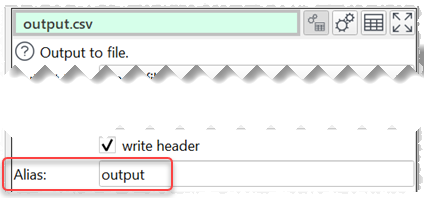
If you are using relative (rather than absolute) locations (paths) for input or output files, these will be relative to the current working folder.
If you are using wildcards, then it is usually a good idea to output to a different folder to the one that you are inputting from.
Select File>Command Line... to show sample command line text which you can copy and modify. It will also warn you of potential issues.
To run on a schedule, call the command line interface (or a script file that calls the command line interface) from a scheduling program, such as Windows Task Scheduler.
See also:
•Input multiple files into a single dataset